Thursday, February 9, 2017

Macaroni cheese

Macaroni cheese 💝


Macaroni and cheese—also called mac and cheese in American, Canadian, and AustralianEnglish; macaroni pie in Caribbean English , and macaroni cheese in the United Kingdom is a dish of English origin, consisting of cooked macaroni pasta and acheese sauce, most commonly cheddar. It can also incorporate other ingredients, such as bread crumbs, meat and vegetables.

50 shades lingerie

Traditional macaroni and cheese is acasserole baked in the oven; however, it may be prepared in a sauce pan on top of the stove or using a packaged mix.The cheese is often first incorporated into a Béchamel sauce (milk gravy) to give a Mornay saucewhich is then added to the pasta. In the United States it is considered a comfort food

Pasta and cheese casseroles have been recorded as early as the 14th century in the Italian cookbook, Liber de Coquina, one of the oldest medieval cookbooks, which featured a dish of parmesan and pasta. A cheese and pasta casserole known as makerouns was recorded in the famous medieval English cookbook, the Forme of Cury, which was also written in the 14th century. It was made with fresh, hand-cut pasta which was sandwiched between a mixture of melted butter and cheese. The recipe given (inMiddle English) was "Take and make a thynne foyle of dowh. and kerve it on peces, and cast hem on boillyng water & seeþ it wele. take chese and grate it and butter cast bynethen and above as losyns. and serue forth." ("Make a thin foil of dough and cut it in pieces. Put them in boiling in water and seethe them well. Grate cheese and add it with butter beneath and above as with losyns [a dish similar tolasagne, and serve.

                       French Maid Set

The first modern recipe for the dish was included in cookery writer Elizabeth Raffald's 1770 book, The Experienced English Housekeeper. Raffald's recipe is for aBéchamel sauce with cheddar cheese in French cooking which is mixed with macaroni, sprinkled withParmesan, and baked until bubbly and golden. The famous British Victorian cookbook Mrs Beeton's Book of Household Management included two recipes for the dish. One recipe states that "The macaroni, (which should be "tender but perfectly firm, no part being allowed to melt, and the form entirely preserved" – lest one be tempted to cook it for so long it actually disintegrated) is then topped with more cheese, pepper and breadcrumbs, before receiving a final dose of melted butter for good measure and being placed before a "bright fire" to brown the crumbs, or grilled with a salamander broiler.

Get the Love With Food Gluten Free Box Deal! 

 In the United Kingdom, during the 2010s, it has seen a surge in popularity, becoming widespread as a meal and as a side order in both fast food and upmarket restaurants.

Our recipe for today is : macaroni cheese 

The ingreadients: 

4 cups dried macaroni
1 whole egg
1/2 stick (4 tablespoons) butter
1/4 cup all-purpose flour
2 1/2 cups whole milk
2 heaping teaspoons dry mustard (more if desired)1 pound sharp Cheddar, grated (not pre-grated cheese), plus more for baking
SaltSeasoned salt
1/2 teaspoon ground black pepperOptional spices: cayenne pepper, paprika, thyme


Directions:

Preheat the oven to 350 degrees F.

Cook the macaroni until still slightly firm. Drain and set aside.

In a small bowl, beat the egg. In a large pot, melt the butter and sprinkle in the flour. Whisk together over medium-low heat. Cook for a couple of minutes, whisking constantly. Don't let it burn. Pour in the milk, add the mustard and whisk until smooth. Cook until very thick, about 5 minutes. Reduce the heat to low.

Take 1/4 cup of the sauce and slowly pour it into the beaten egg, whisking constantly to avoid cooking the eggs. Whisk together until smooth. Pour the egg into the sauce, whisking constantly. Stir until smooth. Add in the cheese and stir to melt. Add 1/2 teaspoon salt, 1/2 teaspoon seasoned salt and the pepper. Add any additional spices if desired. Taste the sauce and add more salt and seasoned salt as needed! DO NOT UNDERSALT.


Pour in the drained, cooked macaroni and stir to combine. Serve immediately (while it's still very creamy) or pour into a buttered baking dish, top with extra cheese and bake until bubbly and golden on top, 20 to 25 minutes.

ENJOY


MADELEINES

MADELEINES😋

Madeleines are very small sponge cakes with a distinctive shell-like shape acquired from being baked in pans with shell-shaped depressions. Aside from the traditional moulded pan, commonly found in stores specialising in kitchen equipment and even hardware stores, no special tools are required to make madeleines.


 A génoise cake batter is used. The flavour is similar to, but somewhat lighter than, sponge cake. Traditional recipes include very finely ground nuts, usually almonds. A variation uses lemon zest, for a pronounced lemony taste.

English madeleines also use a génoise sponge but they are baked in dariole moulds. After cooking, the cakes are coated in jam and desiccated coconut, and are usually topped with a glacé cherry.


Shop Fashion Jewelry at SheIn.com

 The appearance of the madeleine is indicative of the increasing use of metal molds in European baking in the 18th century (see alsoCanelés), but the commercial success of the madeleine dates back to the early years of the 19th century. Several mentions of the madeleine are made by culinary writers during the Napoleonic era, in particular in the recipe books of Antonin Carême and by famous gastronomer Grimod de la Reynière.

50 shades lingerie

In Commercy, the production at a large scale of madeleines is said to have begun in the 1760s. It is likely that the cakes were exported to Paris along with the marmalade from Bar-le-duc and the croquantes fromRheims. Batches of madeleines were often marketed in white pinewood boxes from the neighboring Vosges forest.

During the Bourbon Restoration era, the Commercy madeleines were sold in Paris for 30 centimes. Production picked up during the 1840s, and some 20,000 cakes were produced daily. The success of the madeleines of Commercy was further increased by the development of the railway, which gave the producers an easy access to the Parisian market. By the end of the 19th century, the madeleine is considered a staple of the diet of the French bourgeoisie.

Our recipe for today is : MADELEINES !!

The ingredients :

2/3 cup all-purpose flour, plus more for molds
1 teaspoon baking powder
1/4 teaspoon fleur de sel or pinch of fine sea salt
1/3 cup sugar
Finely grated zest of 1 lemon
2 large eggs, room temperature

1 tablespoon honey
1 teaspoon pure vanilla extract
1/2 cup (1 stick) unsalted butter, melted and warm, plus unmelted for molds
2 tablespoons whole milk

Direction: 

In a medium bowl, whisk together flour, baking powder, and salt; set aside.

Place sugar and lemon zest a bowl. Using your fingertips, rub sugar and lemon zest together until sugar is moist and fragrant. Add eggs and whisk until mixture is pale and thickens slightly, about 2 minutes. Whisk in honey and vanilla. Alternatively, this can be done in the bowl of an electric mixer fitted with the whisk attachment.

Gently fold in flour mixture in three additions; fold in melted butter until fully incorporated. Stir in milk. Batter should be smooth and shiny. Press a piece of plastic wrap against the surface of the batter; transfer to refrigerator and let chill at least 1 hour and up to 2 days.

Butter and flour a large madeleine pan. Spoon batter into madeleine pan; transfer to refrigerator for 1 hour.

Place a heavy, large baking sheet in oven; preheat oven to 400 degrees.


Place madeleine pan on preheated baking sheet. Bake until golden and big bumps on top spring back when touched, 11 to 13 minutes. Remove pan from oven and immediately release madeleines from pan by rapping pan on counter. If any stick, use a butter knife or fingers to help release. Let cool on a wire rack.

BON appetit!!!


Wednesday, February 8, 2017

AMERICAN BISCUIT

  
        BISCUIT   ♡👗


Biscuit is a term used for a diverse variety of baked, commonly flour-based food products. The term is applied to two distinct products inNorth America and the Commonwealth of Nations and Europe. The North American biscuit is typically a soft, leavened quick bread, and is covered in the article Biscuit (bread). This article covers the other type of biscuit, which is typically hard, flat and unleavened.


The need for nutritious, easy-to-store, easy-to-carry, and long-lasting foods on long journeys, in particular at sea, was initially solved by taking live food along with a butcher/cook. However, this took up additional space on what were either horse-powered treks or small ships, reducing the time of travel before additional food was required. This resulted in early armies' adopting the style of hunter-foraging.

The introduction of the baking of processed cereals including the creation of flour provided a more reliable source of food.Egyptian sailors carried a flat, brittle loaf ofmillet bread called dhourra cake while theRomans had a biscuit called buccellum.Roman cookbook Apicius describes: "a thick paste of fine wheat flour was boiled and spread out on a plate. When it had dried and hardened, it was cut up and then fried until crisp, then served with honey and pepper."

Many early physicians believed that most medicinal problems were associated withdigestion. Hence, for both sustenance and avoidance of illness, a daily consumption of a biscuit was considered good for health.


Hard biscuits soften as they age. To solve this problem, early bakers attempted to create the hardest biscuit possible. Because it is so hard and dry, if properly stored and transported, navies' hardtack will survive rough handling and high temperature. Bakedhard, it can be kept without spoiling for years as long as it is kept dry. For long voyages, hardtack was baked four times, rather than the more common two. To soften hardtack for eating, it was often dunked in brine, coffee, or some other liquid or cooked into a skillet meal.

50 shades lingerie 

 At the time of the Spanish Armada in 1588, the daily allowance on board a Royal Navyship was one pound of biscuit plus one gallon of beer. Samuel Pepys in 1667 first regularised naval victualling with varied and nutritious rations. Royal Navy hardtack duringQueen Victoria's reign was made by machine at the Royal Clarence Victualling Yard atGosport, Hampshire, stamped with the Queen's mark and the number of the oven in which they were baked. Biscuits remained an important part of the Royal Navy sailor's diet until the introduction of canned foods. Canned meat was first marketed in 1814; preserved beef in tins was officially added toRoyal Navy rations .


Our recipe for today is : biscuits !!

The ingreadients :

2 cups flour
4 teaspoons baking powder
1/4 teaspoon baking soda
3/4 teaspoon salt
2 tablespoons butter
2 tablespoons shortening
1 cup buttermilk, chilled

8-pack: Ladies' Short-Sleeved Round Neck Striped T-Shirts $24.99 Free Shipping


 Directions:


 Preheat oven to 450 degrees. In a large mixing bowl, combine flour, baking powder, baking soda and salt. Using your fingertips, rub butter and shortening into dry ingredients until mixture looks like crumbs. (The faster the better, you don't want the fats to melt.) Make a well in the center and pour in the chilled buttermilk. Stir just until the dough comes together. The dough will be very sticky.


 Turn dough onto floured surface, dust top with flour and gently fold dough over on itself 5 or 6 times. Press into a 1-inch thick round. Cut out biscuits with a 2-inch cutter, being sure to push straight down through the dough. 
Place biscuits on baking sheet so that they just touch. Reform scrap dough, working it as little as possible and continue cutting. (Biscuits from the second pass will not be quite as light as those from the first, but hey, that's life.) Bake until biscuits are tall and light gold on top, 15 to 20 minutes.

              bon appetit !!!                       


OLIVE BREAD


OLIVE BREAD 🍞

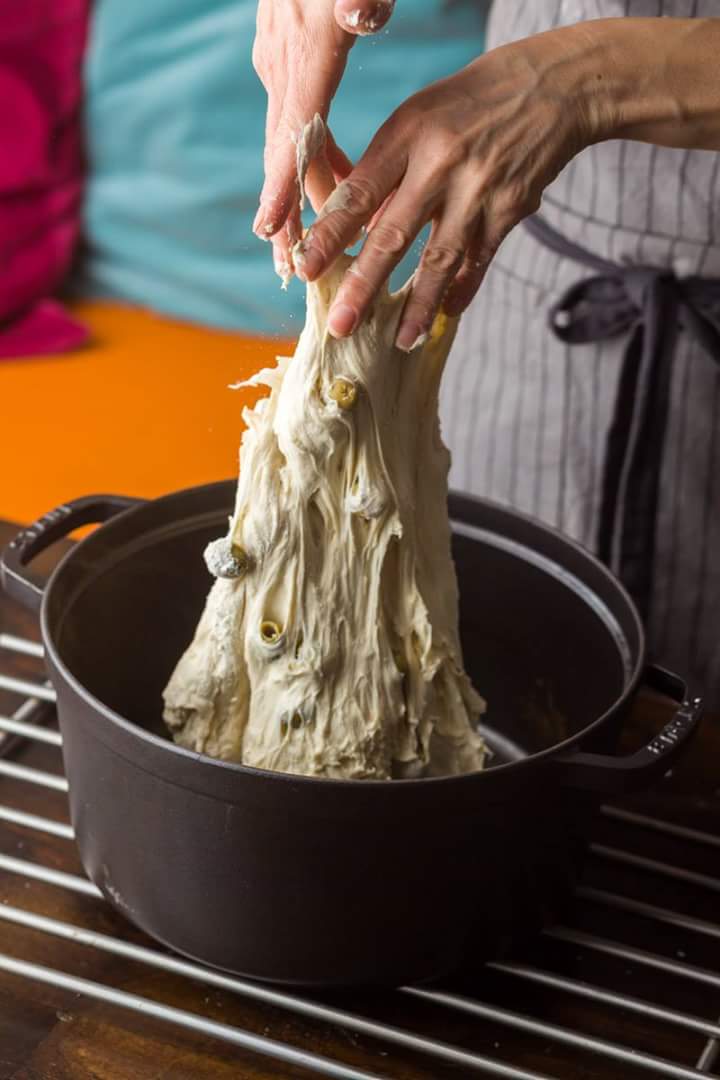
Olive bread is a type of bread which is made with the addition of olives, most commonly the Greek brine-cured olives known as kalamatas, although other varieties of olive are perfectly acceptable. There are a number of different varieties of olive bread, many of which are probably on offer at your local market or bakery. It is also possible to make olive breadat home, giving you greater control over the ingredients.


 Among the many varieties of flavored bread,olive bread is quite popular. It is also extremely versatile. It can be used as a picnic bread, for example, in which case it may be smeared with cheese, dipped in dressings, or dressed with tapenades and other spreads. It can also be used as a table bread, in which case it may be served with oil and vinegar. Olive rolls are also quite common, and they can make a hearty snack when paired with a cheese like feta.

To make olive bread, bakers simply mix dough as they normally would, adding olives to the blend. Olives may also be pressed into thebread before it is baked, although they can be burned when this is done, so they are usually pressed into the bread before the second rising, allowing the bread to rise around the olives, shielding them from the direct heat of the oven.The olives may be whole or sliced, depending on personal taste, and they can be mixed with spices like rosemary or cheeses; blue cheese is a common choice.

50 shades lingerie


The dough base for olive bread may be yeast or sourdough. Sourdough breads have a more chewy, filling texture which complements olives well, while the milder softer yeast doughs are perfectly acceptable. Some cooks may even mix in a bit of whole wheat flour for a hint of nutty flavor. Many olive breads arevegan, with simple doughs which contain just flour, water, oil, and salt.

If you want to make olive bread at home, start with a relatively simple bread recipe which you think would taste good with olives. If you aren't sure, make a plain loaf and try slices with an assortment of olive varieties on the side. Once you've mixed the dough, add in olives as desired, taking care to remove the pits. Some cooks halve their olives, to ensure that the pits are removed before baking. Allow the dough to rise and bake it as you normally would.

I love the idea of a bread with kalamata olives in them. Greek olives are the only kind of olives that I like. I am getting hungry just thinking of this bread and the many ways delicious dips to dip it in.


 I think I will try my first olive bread loaf with an olive oil and basil based bread dip. Then maybe marinara with feta cheese. These two ways seem like they would be a hit appetizer at any party!

Our recipe for today is : olive bread !!

the ingreadients: 

1 1/2 teaspoons instant yeast
2 3/4 cup all-purpose flour
1 cup lukewarm water
1/2 teaspoon salt
1/2 teaspoon garlic powder
2 teaspoons olive oil
1/2 cup pitted, chopped Kalamata olives


The directions:

Combine the first six ingredients in the bowl of a stand mixer. Use a spatula to roughly combine the ingredients. Let rest for 15 minutes to activate the yeast.Fold in the olives. Attach the dough hook and knead on medium for 5 minutes. Sprinkle in a bit more flour as needed if the dough won't release from the sides of the bowl.Transfer the kneaded dough to an oiled bowl, cover, and allow to rise for 60 minutes in a warm place.Punch the dough down, then transfer to a parchment-lined baking sheet. Use your hands to shape it into a loaf. Allow to rise for another 60 minutes.
Preheat your oven to 400 degrees Fahrenheit and place a second baking sheet on the bottom rack. Dust the loaf with flour and use a serrated knife to make three shallow cuts across the top.Place the baking sheet containing the dough on the middle rack of the preheated oven. Toss a half cup of water onto the hot baking sheet on the bottom rack and close the door. Bake for 30 minutes.Let cool completely on a wire rack before slicing.


Fifty Shades of Grey Please Sir Flogger,

Tuesday, February 7, 2017

Moroccan couscous recipe


COUSCOUS 💜

The origin of couscous is uncertain. Lucie Bolens affirms that Berbers were preparing couscous as early as 238 to 149 BC, describing primitive couscous pots found in tombs dating back to the reign of the Berber King Massinissa.Nevertheless, Charles Perry states that couscous originated between the end of the Zirid dynasty and the rise of the Almohadian dynasty between the eleventh and the thirteenth centuries. The remains of the first vessels ( known ) in the Tiaret region ( Algeria ) where cooking tools dating from the ninth century have been discovered, very strongly resemble the primary tool for cooking couscous 

One of the first written references is from an anonymous 13th-century North Africancookbook, Kitāb al-tabǐkh fǐ al-Maghrib wa'l-Andalus "The cookbook of the Maghreb and Andalusia", with a recipe for couscous that was 'known all over the world'. To this day, couscous is known as 'the North Africa national dish Couscous was known to theNasrid royalty in Granada as well. And in the 13th century a Syrian historian from Aleppoincludes four references for couscous.


 These early mentions show that couscous spread rapidly, but generally that couscous was common from Tripolitania to the west, while from Cyrenaica to the east the main cuisine was Egyptian, with couscous as an occasional dish. Today, in Egypt and the Middle East, couscous is known, but in Tunisia, Algeria, Morocco and Libya couscous is a staple. It is also common in Western Africa whence it has spread into Central Africa. It is the national dish of theMaghreb countries. Couscous reachedTurkey from Syria to in the 16th century and is eaten in most of the Turkish southernprovinces.
Couscous is a traditional dish in Trapani, Sicily. In Rome Bartolomeo Scappi's culinary guide of 1570 describes a Moorish dish,succussu.

One of the earliest references to couscous in France is in Brittany, in a letter dated January 12, 1699. But it made an earlier appearance inProvence, where the traveler Jean-Jacques Bouchard wrote of eating it in Toulon in 1630. Couscous was originally made from millet.Historians have different opinions as to whenwheat began to replace the use of millet. The conversion seems to have occurred sometime in the 20th century, although many regions continue to use the traditional millet. Couscous seems to have a North African origin. Archaeological evidence dating back to the 10th century, consisting of kitchen utensils needed to prepare this dish, has been found in this part of the world.

Get the Love With Food Gluten Free Box Deal!


our recipe for todsy is : aMoroccan couscous

Spices   :

1 teaspoon turmeric
1 teaspoon pepper
2 teaspoons ginger
1 teaspoon cumin
1pinch saffron
1 teaspoon paprika
2 teaspoons salt
1 teaspoon coriander

Stew    :

2 lbs lamb or 2 lbs chicken
2 tablespoons olive oil
1 teaspoon minced garlic
1 onion, chopped
4 cups water
1cup tomato sauce
1⁄2 red bell pepper, minced
2 carrots, quartered
2 zucchini, quartered
1yellow squash, quartered
1 medium potato, peeled and quartered
1(16 ounce) can chickpeas

Caramelized Onion Topping:

1onion, minced
2 tablespoons olive oil
3⁄4 cup brown sugar
1 teaspoon cinnamon
3 Tablespoons dried raisin

Couscous:
2 cups dry couscous
3 cups water
4 teaspoons chicken base 
1⁄4 cup butter

50 shades lingerie

The directions: 

Mix all spices in a dish and set aside.Chop meat into large chunks. Heat oil. Brown meat on all sides for 5 minutes.Add onion and garlic. Sauté for 5 more minutes.Add water, spices, and tomato sauce. Cook for 5 minutes.Add carrots and potato pieces. Cook for 10 minutes.Add zucchini and bell pepper to stew. Cook for 20 minutes.Add the chickpeas and cook last 5-10 minutes.

Meanwhile, prepare onion topping. Sauté onions to a light brown color.Add rest of topping ingredients and cook till caramelized and bubbly. Set aside.

Boil the water for couscous. Add chicken base and butter.Add couscous. Make sure this is the last part of the recipe you make.Once the couscous is added, leave it alone for 5 minutes.
Serve any way you like. I plate the cousouse and top it with as much or as little stew as I want. Then I add the vegies that I want and top it all off with the sweet onion/raisin topping.
bon appetit!!!

GRILLED CHICKEN kebabs


kebabs 🍡🍷

Kebab (also American kabob) are variousMiddle Eastern dishes originally based on grilled meat, and now with many variants. Two of the best-known kebab dishes areshish kebab and doner kebab.


 In contemporary American and British English, a kebab is a common dish, consisting of a skewer with small pieces of meat or seafood, together with vegetables such as onions, tomatoes, and bell peppers. Also known as shish kebab or sometimesshashlik, kebabs are customarily prepared in homes and restaurants, and are usually cooked on a grill or barbeque. The word kebab may also be used as a general term in English to describe any similar-looking skewered food, such as brochette, souvlaki, yakitori, or numerous small chunks of any type of food served on a stick. This is different from its use in the Levant, where shish (Persian/Mazandarani -Turkish) is the word for skewer, whilekebab comes from the Persian word forgrilling.

Our recipe for today is : grilled chicken kebabs 


 INGREDIENTS

1 black cardamom pod (may substitute green cardamom pod)

1 1/2 teaspoons ground cinnamon

1/2 teaspoon ground cloves

1 teaspoon cumin seed

1 small red or yellow onion (2 or 3 ounces)
Leaves from 6 to 8 stems cilantro

1-inch piece fresh ginger root

1 medium clove garlic

1 small green chili pepper

1 3/4 to 2 pounds boneless, skinless chicken (preferably a mixture of light and dark meat)

Generous pinch kosher salt

1/4 teaspoon freshly ground black pepper

1 large egg

1/4 cup plain dried bread crumbs (may substitute 1/3 cup packed fresh bread crumbs)


The directions: 

Preheat the oven to 375 degrees. Use nonstick cooking olive oil spray to grease a rimmed baking sheet.

Crush the cardamom pod to release its seeds; transfer them to the baking sheet, along with the cinnamon, cloves and cumin seed. Toast in the oven for 2 minutes, until fragrant. Let cool. Increase the oven temperature to 400 degrees.


As you prep the following ingredients, transfer them to the bowl of a food processor: Coarsely chop the onion (to yield 3/4 cup), the cilantro leaves and some tender stems (to yield 1/4 cup). Peel the ginger, then coarsely chop it along with the garlic. Stem and seed the green chili pepper, then cut it into small chunks. Pulse until evenly chopped, stopping short of a paste consistency. Transfer to a large mixing bowl.


 Remove and discard all visible fat from the chicken. Cut the meat into small, equal-size chunks, then transfer to the food processor. Pulse until evenly chopped, stopping short of a mushy consistency. Transfer to the mixing bowl, along with the salt, black pepper, egg, bread crumbs and toasted spices. Use your clean hands to combine and incorporate the ingredients.

Scoop a small handful into your palm, shaping the mixture to a log that's 3 inches long and 1 inch wide. Place on the baking sheet. Repeat to form 11 more logs, using all the mixture and spacing the logs at least 1 inch apart. Roll and spray them lightly with the nonstick cooking olive oil spray. Bake for 8 to 10 minutes, then turn them over and bake for 6 to 8 minutes or until evenly browned.

Divide among individual plates, skewering them if desired for easy handling.

BON APPETIT!!


Fifty Shades of Grey Please Sir Flogger,

ITALIAN ZAPPOLE recipe


         ITALIAN ZAPPOLE 😄💝


 A Zeppola (plural: zeppole; in southern Italian dialects: zeppole, in north eastern dialects:frittelle) is an Italian pastry consisting of adeep-fried dough ball of varying size but typically about 4 inches (10 cm) in diameter. This doughnut or fritter is usually topped withpowdered sugar, and may be filled withcustard, jelly, cannoli-style pastry cream, or abutter-and-honey mixture. The consistency ranges from light and puffy, to bread- orpasta-like. It is also eaten to celebrate St. Joseph, which is an Italian holiday.


 Zeppole are typical of Italian cuisine, especially that of Rome and Naples. They are also served in Sicily, Sardinia, on the island ofMalta, and in Italian-Canadian and Italian-American communities in Canada and theUnited States. Zeppole are known by other names, including Bignè di San Giuseppe (in Rome), St. Joseph's Day cake, and sfinge. Zeppole are traditionally consumed during the Festa di San Giuseppe (Saint Joseph's Day) celebrated every March 19, when zeppole are sold on many streets and sometimes presented as gifts.


In Istria, Croatia this pastry is called blenzi in the Croatian speaking places and zeppole in the Italian-speaking places.They are always topped with sugar either powdered or coarse.

The custom was popularized in the early 19th century by Neapolitan baker Pasquale Pintauro.

The terms zeppole and sfinge are also used to refer to baked cream puffs made fromchoux pastry.

Some zeppole are filled with ricotta mixed with small pieces of chocolate, candied fruits and honey. In some parts of the U.S., they are called crispellis.

50 shades lingerie 

 Zeppole can also be savory, and consist of fried bread dough often filled with anchovy. In parts of Calabria, the anchovy or a sultana variety are consumed on New Year's Eve and New Year's Day. In Malta, anchovy zeppoli are traditionally consumed during the Lentfasting period. This version of savoury zeppole are known locally as Sfinge. The sweet version is also available in many confectioneries.

In the region of Frosinone in Southern Lazio the term "Sfinge" refers to a mixture of ricotta, sugar and eggs with the flour, which can then be flavored with vanilla, almond, etc. It is still fried in ball shapes served covered with confectioner's sugar.

Our recipe for today is :  ITALIAN ZAPPOLE


The ingreadients: 


1 vanilla bean

1/2 cup sugar, plus 3 tablespoons

2 tablespoons ground cinnamon

1 stick butter

1/4 teaspoon salt

1 cup water

1 cup all-purpose flour

4 eggs

Olive oil, for frying

  Only Natural Pet - Everything Natural for   Dogs & Cats

The directions: 

Cut open the vanilla bean lengthwise. Using the back of a knife, scrape along the inside of the vanilla bean to collect the seeds. Scrape vanilla bean seeds into a small bowl. Add the 1/2 cup sugar and cinnamon and stir to combine. Set aside.

In a medium saucepan combine the butter, salt, 3 tablespoons of sugar, and water over medium heat. Bring to a boil. Take pan off the heat and stir in the flour. Return pan to the heat and stir continuously until mixture forms a ball, about 3 to 5 minutes. Transfer the flour mixture to a medium bowl. Using an electric hand mixer on low speed, add eggs, 1 at a time, incorporating each egg completely before adding the next. Beat until smooth. If not frying immediately, cover with plastic wrap and reserve in the refrigerator.

Meanwhile, pour enough oil into a largefrying pan to reach a depth of 2 inches. Heat the oil over medium heat until a deep-fry thermometer registers 375 degrees F.

Using a small ice-cream scooper or 2 small spoons, carefully drop about a tablespoon of the dough into the hot olive oil, frying in batches. Turn the zeppole once or twice, cooking until golden and puffed up, about 5 minutes. Drain on paper towels. Toss with cinnamon-sugar. Arrange on a platter and serve immediately.

BON APPETIT!!!!